
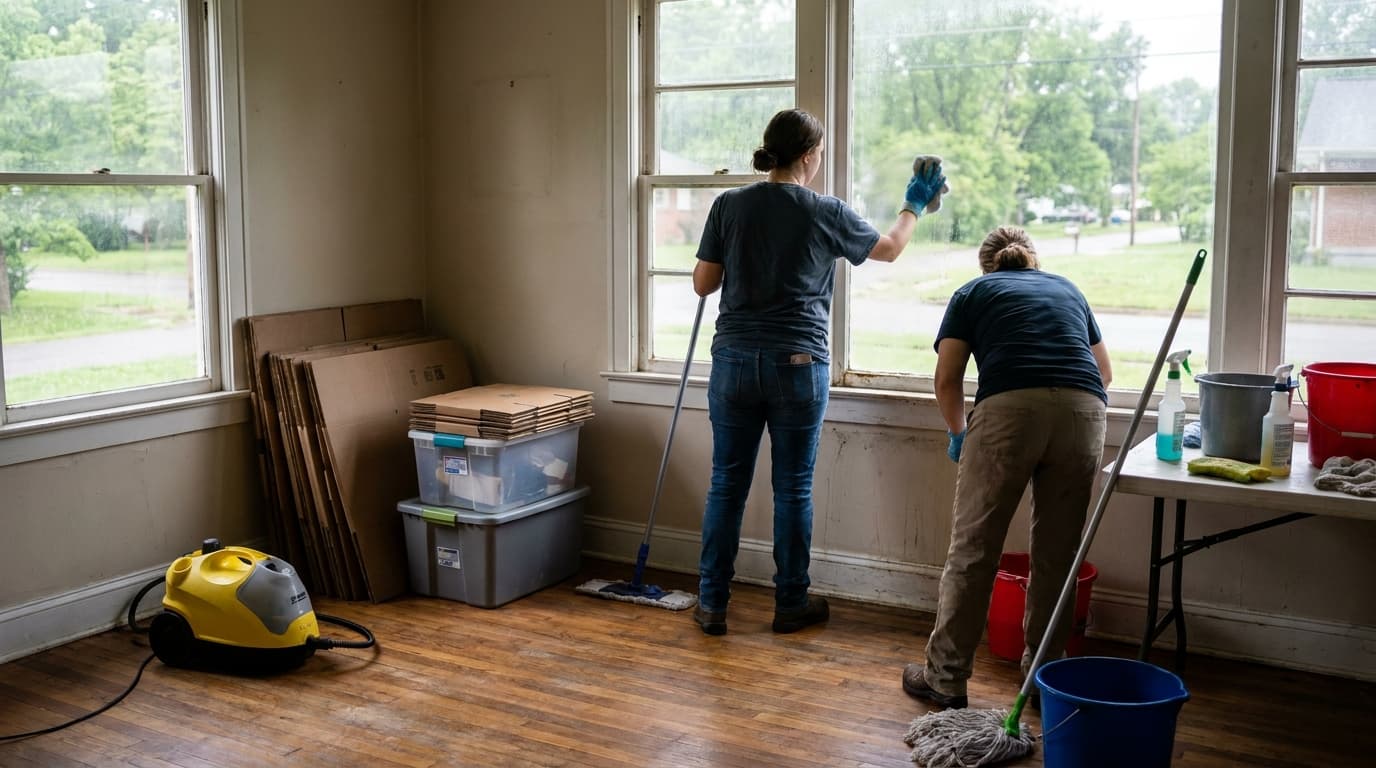
Knox County move-out cleaning
A Knox County move-out cleaning is the sanitary turnover you book so the next lease does not start in leftover trash, grease, or pest harborage.
- The unit has to be clean and free of refuse before re-occupancy.
- Grease and pest harborage are the health-code problem, not a style problem.
- A campus checkout with a bursar fine is a different page.
Knox County Housing Code Section 302 is the local rule beside the state landlord-tenant statute. The dwelling has to be clean, sanitary, and free of refuse.
The turnover inspection this brief names happens before the new occupant’s lease starts. A sale closing can use the same sanitary pass when the house has to be empty and broom-ready for a buyer.
- Garbage, pest harborage, and organic grease are the failures Section 302 is written to stop between tenancies.
- A housing inspector or the property management agent is who signs off.
- Skip it and you risk a code warning, a deposit hold, or a delayed start for the incoming tenant.
What Section 302 means on an empty unit
Knox County Environmental Health treats a dwelling between tenants as a sanitation problem, not only a deposit argument. Housing Code Section 302 says the unit has to be clean, sanitary, and free of refuse before it is occupied again. The local fact on this page is sharper: the standard is there to cut pest harborage and the buildup that feeds mold spores between tenancies. Organic grease in a cold oven is food. A bag of trash in the garage is harborage. A “we’ll leave it for the next person” fridge is both.
This sits next to the state landlord-tenant statute. The health department line is why Knox is not just another URLTA county with the name swapped. A landlord can still deduct under the lease. Separately, the unit is not supposed to be re-leased while it is full of garbage and grease. The rule this page quotes is that freedom from garbage, pest harborage, and organic grease residues before the new occupant’s lease begins.
Walk the unit the way an inspector walks it. Open the oven, the fridge, and the under-sink cabinet. Smell the disposal. Look at the garage slab and the closets, because refuse migrates there on moving day. A sparkling counter with a full trash bag behind the water heater is still a Section 302 problem. If you are selling rather than re-leasing, do the same walk before the buyer’s final visit. The housing code is written for occupancy. A closing still punishes a greasy, trash-filled house, and the crew you book should be told which appointment they are racing.
Knox County housing code, Section 302

What a skipped turnover does to the next lease
The consequences named here are code compliance warnings, landlord deposit withholdings, or a delayed lease start for the incoming tenant. Those are different pains. A warning is the county. A withholding is the landlord. A delay is the next renter standing on the porch. None of them is fixed by a scented candle.
If the job is a home sale rather than a lease, the same sanitary pass still matters when the contract expects an empty, clean house at closing. The housing code is written for dwellings and re-occupancy. It does not become a mold-remediation spec because a buyer is nervous. Active growth is a different trade. Say so on the callback instead of hoping a mop is a remediator.
Who signs, who pays, and how long
| Item | What this page can say |
|---|---|
| Who signs | Knox County housing inspector or property management agent. |
| Who pays the crew | The tenant, seller, or manager who booked the clean. No fee is printed in Section 302. |
| How long | Turnover inspection before the new tenant occupies the unit. |
| If you skip it | Code warnings, deposit withholdings, or a delayed lease start. |
| How the next place differs | Campus housing at UT Knoxville adds a checkout appointment and a published fine tier this health code does not use. |
Why campus checkout is not this page
Knox County enforces a local health-department housing standard alongside the state landlord-tenant statute. That pairing is the reason this URL exists. A county that only waves at the state deposit statute, without Section 302, would not earn the same page.
University of Tennessee Knoxville student housing is inside the Knoxville area and still gets its own page, because the housing office publishes a checkout appointment and a fine tier for uncleaned student units. A family rental or a sale in the county stays here. A shared student kitchen with an RA and a bursar hold belongs on the campus page.
Checklist for a sanitary Knox County turnover
- Decide whether this is a lease turnover or a sale closing, and say which on the form.
- Remove trash from the kitchen, baths, closets, and garage. Refuse is the code word that matters.
- Degrease the range and wipe every shelf that held food.
- Look under sinks for damp cardboard and other pest harborage.
- Do not book this crew for mold remediation. Flag active growth as a different job.
- Ask the manager whether they want a crew receipt. The housing code does not require one.
- Finish before the new occupant’s lease, not the weekend after they move in.
- Walk the empty rooms in daylight and photograph the kitchen and baths.
No published hours and no published price
The timeline is a turnover inspection before the new tenant takes occupancy. Section 302 does not say how many hours a three-bedroom takes, and this page will not invent a stopwatch. Square footage and whether the oven, fridge, or carpets need a deep pass change the day. There is no cleaning fee in the housing-code fact this page uses. Who signs is the housing inspector or the property management agent. Who pays the crew is the person who hired them.
Questions people ask before they book
Q1. What are Knox County's sanitary standards for rental home re-occupancy?
Section 302 wants the dwelling clean, sanitary, and free of refuse before someone new moves in. This page’s local reading adds pest harborage and organic grease, because those are what feed pests and spore problems between tenancies. It is a sanitation standard, not a decorating standard.
Q2. Do Knox County landlords require receipt proof from a professional cleaning company?
The housing code cares that the unit is sanitary. It does not, in the material this page uses, require a receipt from a named company. A lease might. Bring a receipt if your manager asks. Do not confuse a lease habit with a line in Section 302.
Q3. How long does a 3-bedroom home move-out clean take?
No hour count is published for a three-bedroom. A bare, already-swept house is a shorter day than a greasy kitchen plus carpet steam. Say the bedrooms, the square footage, and the add-ons on the callback and let the crew name the hours.
Q4. Is mold remediation included in move-out cleaning?
No. Section 302 is sanitation and refuse, plus the pest and grease problems named on this page. Move-out cleaning is not mold remediation. If you see active growth, say so. Expect a different trade, and do not let a mop crew pretend to be that trade.